Use of prompt engineering in preparing job interviews
Do your answers in a job interview sound artificial, as though learnt by heart? How can AI help you avoid pitfalls of narrative patterns such as STAR, CARL, Minto / McKinsey Pyramid, etc?
TLDR;
Try the following prompt:
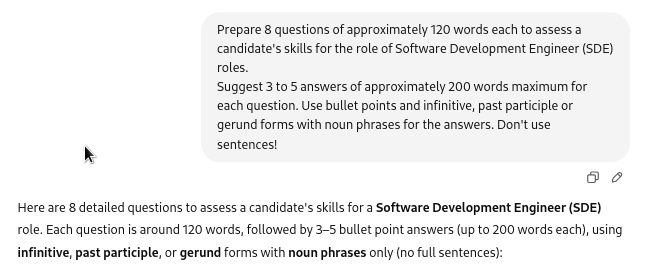
    Prepare 12 questions of approximately 120 words each for a job interview at (...).
    Suggest 3 to 5 answers of approximately 200 words maximum for each question.
    Use bullet points and infinitive, past participle or gerund forms with noun phrases for the answers.
    Don't use sentences!
    Use unmarked register, be polite but not distant or condescending.
    (...)
Practise oral deliver using discourse variations:
✓ rehearse delivery by changing the order of bullet points & discourse markers
(...)
Now read further if you are preparing for job interviews or work as a headhunter...
[top]
Teething problems
The challenge nowadays is not to find a list of questions to prepare for: there is a myriad of posts on LinkedIn and articles on the internet which cover a range of questions a candidate may be asked:
✓ background check at preliminary stages (pre-screening)
✓ during the highly-competitive hard skills stage
✓ when going through behavioural questions relevant to team matching
Leveraging AI to improve language in describing your support stories is probably not a problem for most digital migrants and/or non-native speakers either:
✓ literally ask AI to check your answers for grammar and spelling mistakes
✓ ask to refine language
〆sound like a native speaker can be quite vague though...
[top]
New challenges
Reliance on AI means the first draft of questions and answers will be anonymous:
→ systematically request details for a position in a given region, corporate culture, etc
e.g. Suggest arguments for a start-up in Europe featuring a Teal organisation
e.g. Suggest arguments for a big tech in the USA featuring a strong commitment to EDI (BrEn) | DEI (AmEn)
Refining prompts to get the best questions and answers can soon feel reminiscent of the Rabbit Hole Syndrome or simply over-engineering.
→ limit each question to approximately 150 words
→ ask for suggested answers with no more than 300 words
[top]
Versioning with AI
It's much easier to be critical of AI suggested questions and answers for a job interview when you can compare them with reality, or at least are given a range of options to choose from:
✓ ask for 15 questions but select only the 10-12 most relevant ones
→ this step is already giving you an idea of what support stories you will need because some questions and answers will overlap
Request at least 3 distinct versions:
✓ rephrase the same question
e.g. for a junior, middle and senior position
→ this should indicate what achievements you'll have to focus on in your support stories to target your desired level
[top]
Hints for non-native speakers
While language learners at more advanced levels (B2 - C1 per CEFR) are aware of registers (formal, unmarked, informal, friendly, emphatic), they may still struggle to recognise what AI has suggested.
When prompting, ask AI to provide the same answer also with different tones / registers:
    ✓ use unmarked language
    → avoid phrasal verbs which can be confusing for non-native speakers
    ✓ suggest no more than 3-5 buzzwords relevant to this industry
    → avoid excessive jargon
    ✓ emphasise success with one or two positive adjectives only
    → don't use emphatic language
[top]
Common mistakes
Don't count on recycling the same support stories to give evidence of your greatest achievements and mentoring. By now, you should have 10-12 support stories to answer approximately 15-18 questions:
✓ you need more questions than you will have time for at interview because you should also be ready for different stages with a variety of interlocutors
〆AI can help rephrase your soft skills or re-focus on metrics of a particular success story, but follow-up questions of a human recruiter will soon point to little experience in a given field
Practising oral delivery alone without checking for your listener's feedback results in a monotonous speech:
〆don't use AI to write prose or else you are likely to learn by heart
    While I was responsible for developing all the documentation in this start-up
    I developed and supported different user guides.
    I also created tasks to rewrite sections with bounce rates exceeding 30%.
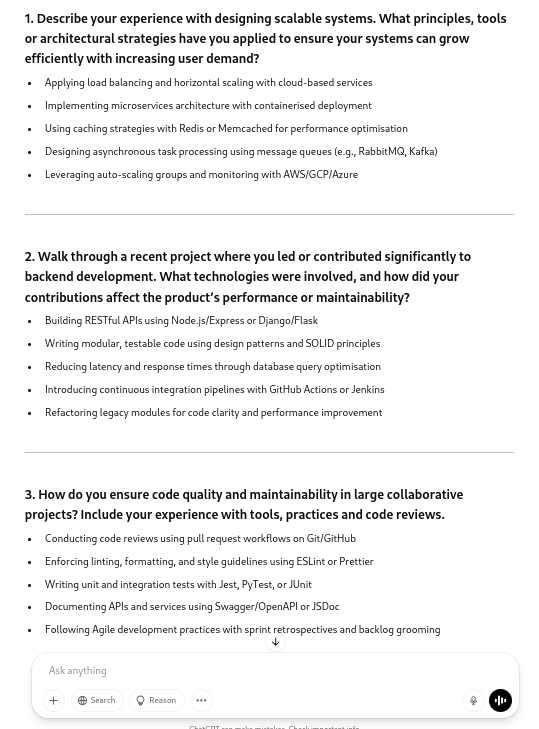
✓ ask AI to break down your ideas into short sentences which you can improvise with more easily:
    • responsible for developing all the documentation in this start-up
    • developed and supported different user guides
    • created tasks to rewrite sections with bounce rates exceeding 30%
Bullet points force the speaker not to read support stories like prose
[top]
Discourse variations
If this article were entitled Discourse variations instead of something trendy about AI & prompt engineering it probably wouldn't attract much attention...
Now, however, it should be clear why disclosing prompts is not shooting oneself in the foot: we should expect candidates to be ready & have already completed some of these steps:
    Prepare 12 questions of approximately 120 words each for a job interview at (...)
    Suggest 3 to 5 answers of approximately 200 words maximum for each question.
    Use bullet points and infinitive, past participle or gerund forms with noun phrases for the answers.
    Don't use sentences!
    Use unmarked register, be polite but not distant or condescending.
    (...)
[top]
Rehearsing mock interviews
This is when coaching with your sparring partner really begins.
Practise oral deliver using discourse variations:
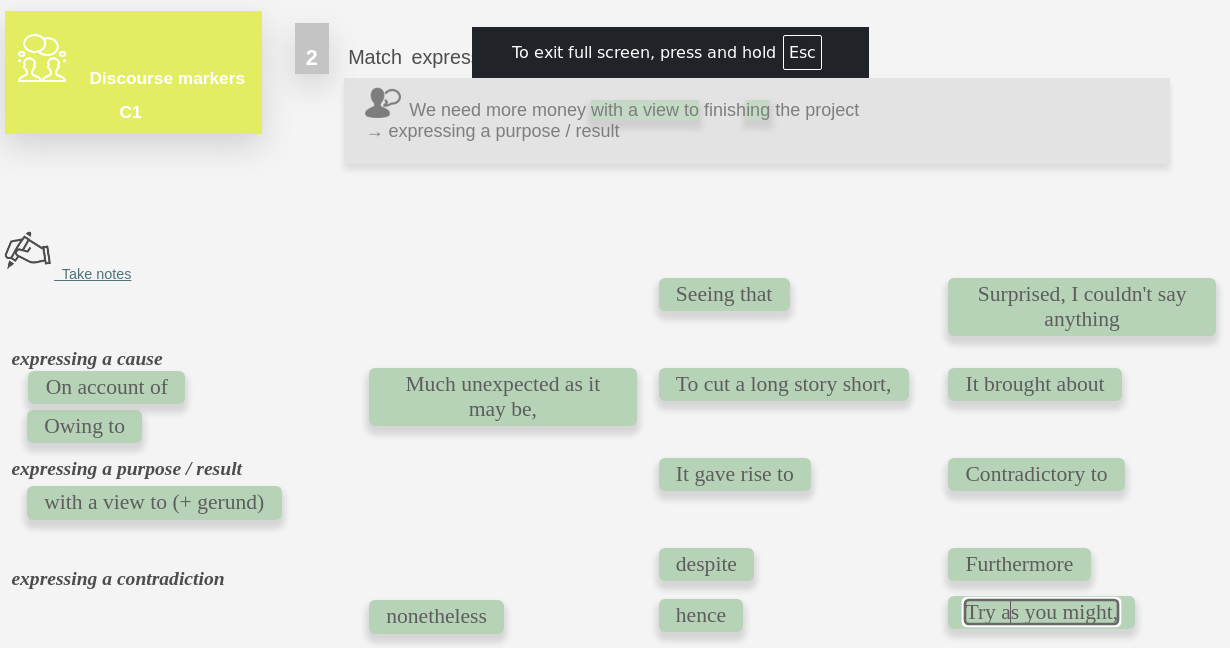
✓ rehearse delivery by changing the order of bullet points, ensuring a cohesive flow with discourse markers (so, therefore, although...) & various narrative patterns
e.g. start with metrics to make an impact (Bottom Line Up First)
I rewrote sections with bounce rates exceeding 30%!
OR
e.g. start with results (i.e. the conclusion) to interest your listener (Minto / McKinsey Pyramid)
We developed and supported different user guides successfully despite some hurdles.
OR
e.g. use STAR to narrate professional experience
In those days I was responsible for developing all the documentation in this start-up. (= situation)
✓ use fluency markers to pretend you are thinking aloud
e.g. Er, Hmm, Well, let me think...
Don't regurgitate your STAR, CARL (Context, Action, Results, Learning), Minto / McKinsey Pyramid support stories like a monologue:
→ engage your listener in a more natural conversation by asking simple (rhetorical) questions
e.g. Would you like to know more? Shall I continue or have you got any questions?
Imagine follow-up questions which AI couldn't ask:
✓ paraphrase key expressions / buzzwords related more specifically to your industry
✓ use Maieutics (Socratese method) to elicit possible weaknesses
✓ enquire about implicit aspects which are not voiced in the answer
e.g. Did you run any script to automagically collect comments embedded in the code of developers?
(...)
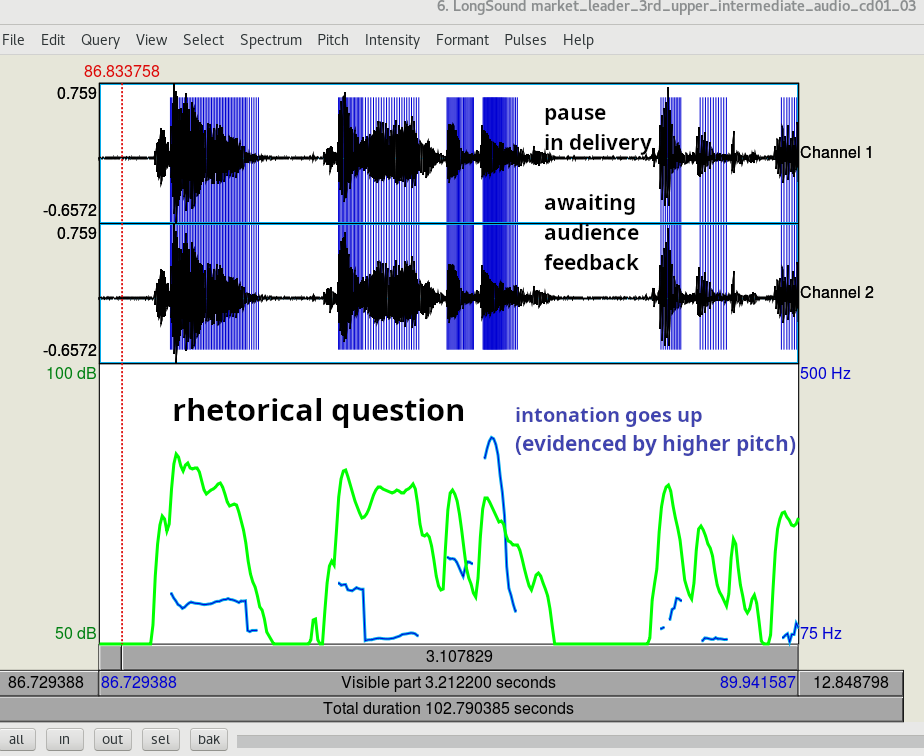
Record yourself and analyse the delivery in terms of voice modulation using speech analysis software Praat
→ look for variations in pitch to show rhetorical questions, repeated patterns suggesting assertiveness...
[top]
Soviet montage theory vs discourse variations
AI is a double-edged sword: it helps build appealing stories at the cost of natural delivery (think prose & monologue vs 2-way conversation).
A workaround to mitigate this risk is using discourse variations, which are reminiscent of the Soviet montage theory:
Montage is an idea that arises from the collision of independent shots wherein each sequential element is perceived not next to the other, but on top of the other
    If you want to pass an interview you have to create conditions to sound more natural
    In other words, include opportunities for different interpretations
    In conclusion, do not rely on perfect, ready-made answers and learn them by heart
    Although it is tempting to rely on perfect, ready-made answers and learn them by heart
    In a job interview it's often more important to create conditions to sound more natural
    that's why you need to include opportunities for different interpretations
    AI prompting can include opportunities for different interpretations
    therefore you shouldn't just rely on perfect, ready-made answers and learn them by heart
    To get your dream job, you ought to create conditions to sound more natural
There is no perfect version, what matters is what you want to stress.
→ use bullet points in AI-generated answers for discourse variations